
Every WhatsApp pitch starts with the same hook. Open rates near 98 percent, email stuck in the low twenties, so move your budget over and watch the orders come in. The open rate part is broadly true. The conclusion people draw from it is where most ecommerce brands lose money.
A near-universal open rate tells you almost nothing about whether someone read your message or did anything after. All it confirms is that the notification fired and your text showed up on a screen. That's a visibility number wearing a conversion costume. Anyone who's run a few WhatsApp campaigns knows the gap already - the broadcast went out, the dashboard lit up green, and the revenue line sat there.
This is about that gap. The real difference between a plain broadcast and an AI-personalised campaign, why the open rate stopped being the interesting number a long time ago, and how to spend on WhatsApp so opens turn into orders instead of unsubscribes. If you're a founder or growth marketer weighing this channel, the aim is to save you a quarter of wasted sends.
What the open rate measures
WhatsApp open rates run high for structural reasons, not because your copy is sharp. The app sits on the home screen, notifications are on by default, and the platform still feels like a personal space rather than a promotions folder. A message lands, the badge appears, the eye goes to it. That's the whole mechanism.
Email can't match it, partly because email opens depend on a tracking pixel loading, and privacy features and corporate mail systems break that pixel constantly. So email open rates are both lower and shakier as a measurement. WhatsApp doesn't have that problem, which is why the comparison looks so lopsided on a slide.
Now the part the decks skip. An open on WhatsApp can mean someone swiped the notification away to clear the badge. It can mean they glanced, thought "promo", and closed it. None of that is engagement. When a brand says their open rate is sky high, the questions that matter are the same every time. What's your reply rate? How many people tap the link? How many block you? Those tell you whether the channel is working. The open rate only tells you the pipes are connected.
The number that deserves your attention is how many people block or report you. WhatsApp watches that closely and it feeds straight into how the platform treats your account. A campaign opened by nearly everyone and reported by a noticeable slice of them is a campaign slowly strangling your own reach. If your reporting begins and ends with open rate, you're flying on the one instrument that can't tell you whether you're about to crash.
If open rates are 98%, why are my campaigns stuck at 70-80%?
Open your dashboard and the 98 percent never shows up. You see something in the 70s, maybe low 80s, and it doesn't match anything you've read. The gap isn't a reporting bug. The 98 percent and your 70-80 percent measure different things, and the one bothering you isn't even the open rate.
The famous 98 is a read rate, and it only counts messages that were delivered. Of the messages that landed on a phone, almost all got opened. Your 70-80 is most likely your delivery rate, an earlier step. Of the messages you tried to send, only this many reached a phone. A message that never delivers can never be opened, so it never enters the 98 percent calculation. The high number excludes your biggest problem, and the real question isn't why your open rate is low, it's why your messages aren't being delivered. For most ecommerce brands this past year, that comes down to one Meta change.
Frequency capping is the main culprit. Meta now limits how many marketing messages a single person can receive in a day, counted across every business, not only yours. Industry reporting and BSP documentation put it at roughly two marketing template messages per user per 24 hours before Meta starts refusing to deliver more. The cap is dynamic and Meta doesn't publish the rules, but the effect is consistent: if your customer already got promotional messages from two other shops this morning, yours may simply not be delivered, however clean your template or list. You're not blocked and your account isn't broken. The recipient is what the ecosystem calls saturated, and the platform returns a specific error instead of delivering. That's why so many brands watched delivery fall from the 80-90 range into the 50-70 range over the past year without changing anything on their end.
A few other things drag delivery down too. A low quality rating means Meta filters more of your marketing messages before they reach people. Recipients who blocked your number get nothing, and a high block rate worsens the quality rating that controls everything else. Dead numbers on an old list fail silently. And messages Meta judges "less likely to be read" get dropped first, so stale, generic broadcasts are exactly the ones that disappear. Stack those together and 70-80 percent delivery isn't a mystery. It's the predictable result of sending marketing-category messages to a broad list in a system built to throttle exactly that.
The fix isn't to send more to make up the shortfall, because that pushes you into the frequency cap and the quality penalty that make it worse. Send messages people want and reply to, since a reply opens a window where you're no longer competing against the marketing cap. Utility messages people expect, like order and shipping updates, sail through where promotional blasts get filtered. Personalised, behaviour-triggered messages dodge the cap better than mass broadcasts because they reach fewer people at moments those people care about. Clean your list so dead numbers stop dragging the rate down. It's working with how the platform decides what to deliver instead of against it.
Broadcast versus AI-personalised: the real split
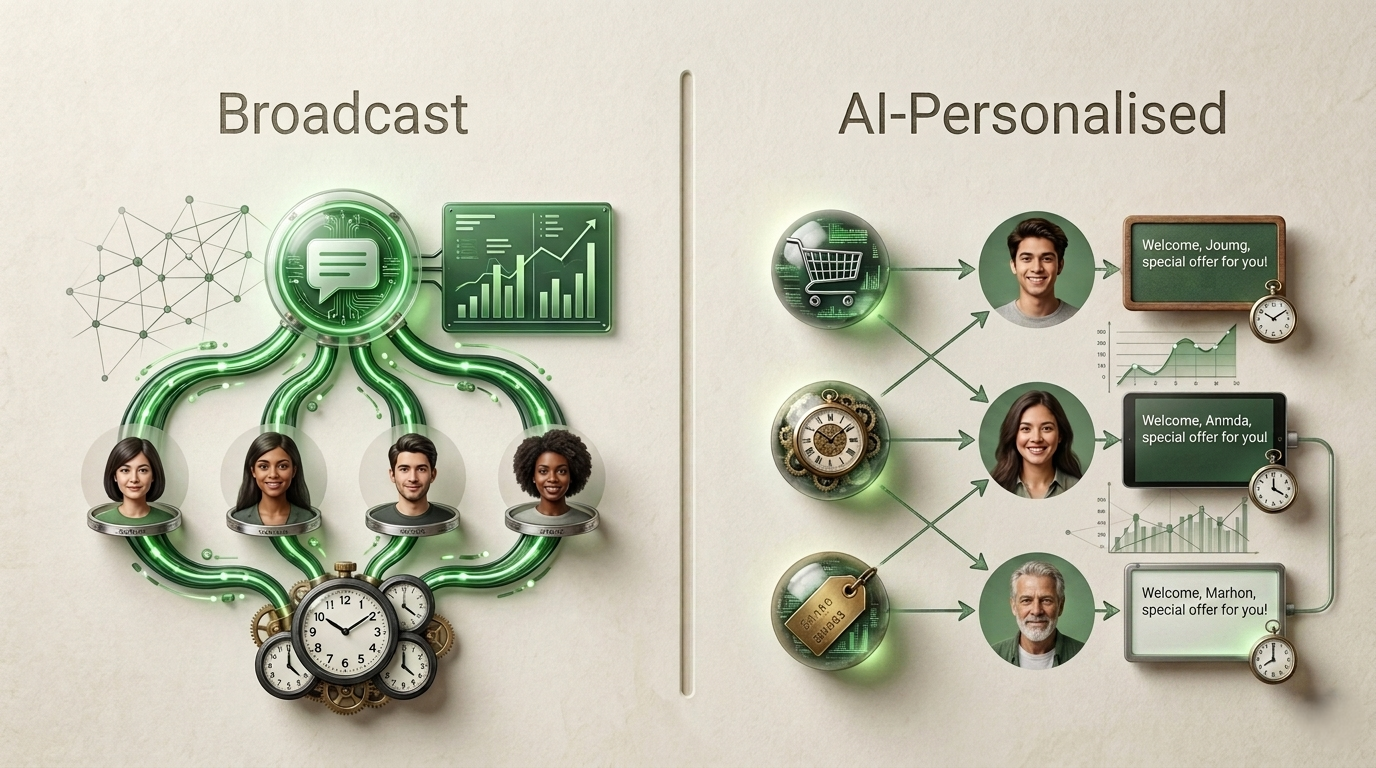
That last point, personalised messages getting through where broadcasts get filtered, is worth slowing down on, because most teams think the choice is between one message to everybody and a slightly different message to a couple of segments. That undersells it. The real difference is what sets the message off and what the message knows about the person on the other end.
A broadcast is a push. You write one template, choose a list, fire. Everyone gets the same thing at the same moment regardless of where they sit in their relationship with you. It's the WhatsApp version of a billboard, and like billboards, broadcasts earn their keep for genuine mass-relevance moments and waste money on everything else.
An AI-personalised campaign behaves more like a conversation the system runs on your behalf. The trigger is behavioural - a cart untouched for a couple of hours, a repeat buyer quiet for two months, a product someone kept eyeing just dropped in price. The content shifts on what that person did or bought, and the timing leans toward when they tend to open things. Nobody hand-writes each message. It runs off your customer data and a layer of logic that decides what to send and when.
We're not anti-broadcast. A real sitewide sale, a limited drop with honest scarcity, a festival-rush notice about store hours - these are mass-relevance events and a broadcast is the clean tool. The mistake is reaching for broadcast as the default for everything because it's the quickest thing to set up in a dashboard.
Send one broadcast a week to your whole opted-in list, same offer, same time, and this is what happens. Opens stay high the entire time. Revenue per send drifts down week after week, and blocks creep up, because most of the list had no reason to buy that week. You're paying to slowly train your best customers to mute you. Cut the weekly blast and move the effort into a small set of triggered flows - cart recovery, a reorder nudge timed to roughly when each customer runs low, a win-back for people who've gone dark - and fewer messages go out overall while revenue per message climbs and the block rate settles, because people get messages that match their actual moment.
That's the whole argument. Personalisation isn't about being clever. It's about not sending people things they have no reason to care about, which protects your conversion rate and your sending reputation at the same time.
Messaging rates change the math
The platform has shifted toward charging per message, which makes each unnecessary send a real, traceable cost rather than a rounding error hidden in a bundle. Marketing, utility and authentication are priced differently, and marketing, the one you most want to scale, is typically the least forgiving on cost. So the broadcasts you're tempted to send more of are exactly the ones that stay expensive per message however many you fire. Cost also depends on where your customers are, so a blast that feels almost free on a domestic list gets uncomfortable on an international one.
The other half is how much you're even allowed to send. New accounts don't message the whole list on day one. The platform starts you conservatively and raises your ceiling as you prove you send well - low blocks, healthy engagement - not by pushing harder. A poorly targeted blast that triggers blocks drags down your quality rating, which slows your climb to higher limits and gets more of your messages filtered before delivery. Your sending limit isn't a fixed pipe, it's a score you move with every campaign.
Put the cost picture next to the sending-limit picture and you get the same answer twice. When every message is billed, promotional sends never get a real discount, and account quality decides how far you can scale, the brand sending fewer, sharper messages wins on conversion and pays less.
The AI rule most brands missed
If your personalisation plan is to bolt a general-purpose chatbot onto your WhatsApp number, reconsider. The platform tightened its stance, and open-ended AI assistants without a defined job are no longer welcome on business numbers. Only task-specific agents built for clear purposes like support or product help are allowed.
For ecommerce that's barely a constraint, because the AI that drives revenue is task-specific anyway. A flow that recommends products from your catalogue, answers an order question, or recovers a cart has a defined purpose. A do-anything assistant parked on your business line doesn't, and now it's a policy risk on top of being a weak revenue tool.
The useful "AI" here is smart triggering, dynamic content, and timing that adapts to behaviour, all running off your own customer data - not handing the conversation to an open-ended model and hoping it behaves. Try to automate every edge case and you end up with something that handles nothing well. Automation is for removing the repetitive, predictable work, not replacing judgement on the messy stuff.
What a real programme looks like
A WhatsApp programme for an ecommerce brand looks less like a broadcast calendar and more like a small set of always-on flows with the occasional genuine broadcast on top.
The flows that consistently earn their place: cart recovery soon after abandonment, order and shipping updates because they're cheap and wanted, a reorder nudge for anything people use up, and a win-back for customers who've gone quiet. Behavioural, personalised, and they run without anyone touching them after setup. They do the boring, repetitive work that drives most of the revenue.
Broadcasts sit on top, reserved for the handful of moments a year when the same message really is relevant to your whole list - a couple of true broadcasts a quarter, a festival package, an end-of-season clearance - with everything else, confirmations, pre-arrival nudges, review requests, running through triggered flows. Do it that way and cost per message drops and the block rate stays near zero, because the only mass messages you send are ones people are already expecting.
The honest caveat is that none of this runs fully on autopilot. Personalisation is only as good as your customer data, and messy data produces confidently wrong messages, which land worse than generic ones. Triggered flows still need a human checking the numbers every couple of weeks, watching the block rate, and retiring templates the platform is starting to dislike. And there are always moments - a delayed order, an angry reply, a complicated return - where the right move is to put a real person into the conversation quickly.
The famous open rate is real, and it's the least useful number on your dashboard. It confirms the pipe is connected, not that anyone cared. The brands wasting WhatsApp treat that number as proof their broadcasts work, then send more until their best customers start blocking and the platform starts throttling. Spend on WhatsApp like the messages cost money, because they do, and treat account quality as something you can lose. Get those two instincts right and the open rate stops being something you have to worry about.
If your inbox is already live with us, set up cart recovery next, it tends to pay for the whole setup faster than anything else. And before pouring budget into campaigns, it's worth knowing where buying is heading.
FAQ
Is the 98% open rate accurate or marketing hype?
Broadly accurate, widely misread. WhatsApp open rates run high because notifications are on by default and the app sits front and centre. What an open doesn't tell you is whether the person read, cared or acted - a swipe to clear a notification registers as an open. Treat it as a visibility metric and judge campaigns on reply rate, link taps and block rate.
Why is my delivery rate stuck at 70-80% when open rates are 98%?
Because they measure different stages. The 98 percent read rate only counts messages that were delivered, so it hides the problem. Your 70-80 percent is a delivery rate, mostly held down by Meta's frequency capping, which limits how many marketing messages a person receives per day across all brands. If a customer already hit that cap from other businesses, your message won't deliver. Low quality ratings, blocks and dead numbers pull it down further.
When should we use a broadcast instead of a personalised campaign?
Only when the same message is genuinely relevant to your entire opted-in list at the same moment - a real sitewide sale, a limited drop, a festival or store-hours notice. For anything tied to individual behaviour (browsing, cart status, purchase history, lapsed activity) a triggered personalised flow converts better and protects your block rate. The common mistake is defaulting to broadcast because it's fastest to set up.
How do messaging rates affect campaign cost?
Messages are charged so that each unnecessary send is a real cost, and promotional messages are the least forgiving category to scale. Cost also depends on where your customers are, so the same campaign can be cheap to one list and pricey to another. High-volume broadcasting is more expensive than it looks, and tighter, behaviour-based targeting usually wins on pure economics before you count conversion.
What rate limits should a new ecommerce brand expect?
New accounts start with a conservative sending ceiling and earn higher limits by sending well - low blocks and reports, healthy engagement - not by sending aggressively. Poor targeting that triggers blocks lowers how the platform rates your account, which can slow or freeze your progress and reduce delivery of messages you've already paid for. Think of the limit as a score you affect with every campaign.
Can we add a general chatbot to our WhatsApp number for personalisation?
No, and the platform now restricts it. Open-ended AI assistants without a defined purpose aren't allowed on business numbers. Only task-specific agents built for clear jobs like support or product help are permitted. For ecommerce that's not a real limitation, because the AI that drives revenue - smart triggers, dynamic product content, behaviour-based timing - is task-specific anyway.
What's the minimum setup to see real results from WhatsApp?
One behavioural flow rather than a broadcast calendar. Cart recovery is usually fastest to pay for itself: a personalised message a short while after abandonment, with the product and a direct path back. Add order and shipping updates, since they're cheap and wanted. Get those two right, keep your data clean, and watch your block rate before layering on more.
How do small teams run personalised campaigns without burning out?
The point of AI-personalised campaigns is that they run without daily effort once configured. Set up the core triggered flows - cart recovery, shipping updates, reorder nudges, win-back - and let them fire on behaviour from your customer data. The recurring human work is light: check the numbers every couple of weeks, watch block and quality signals, retire weak templates, and stay reachable for the conversations that need a person. Small teams get into trouble sending constant manual broadcasts instead of letting good flows handle the repetitive work.
Read more

WhatsApp Usernames for Business: What Changes in 2026
WhatsApp usernames are live and reservations are open globally. What they change for a business, why the BSUID underneath matters more than the handle, and what to check in your CRM before your market's rollout wave.

Answer Engine Optimization for Ecommerce: Getting Recommended by ChatGPT and Gemini
How answer engine optimization works for an ecommerce catalog, what changes at the SKU and feed level, and what it takes to get a product named inside a ChatGPT, Gemini or WhatsApp shopping answer.

WhatsApp Frequency Capping: Why Your Campaigns Fail to Deliver
WhatsApp frequency capping isn't a fixed number you can look up. How the per-user limit really works, which messages are exempt, how it differs from tier limits and quality rating, and what's inside your control.